Liquidity providers explained: from TradFi market makers to DeFi pools

A liquidity provider supplies assets to a market so trades can happen efficiently, whether that is a bank continuously quoting currency prices or a DeFi user depositing tokens into a liquidity pool. The role is similar, but the way liquidity provision works in traditional finance and DeFi is fundamentally different.
Liquidity is what makes every trade possible. In traditional markets, banks and professional market makers provide it. In DeFi, smart contracts and liquidity pools have opened that role to individual crypto holders.
The basic purpose remains the same: make assets available so other market participants can trade them. But how liquidity providers supply capital, how prices are determined and how LPs are compensated differ significantly between the two systems. Here's how liquidity providers work, how the role changed with DeFi and what you need to consider before becoming one.
What is a liquidity provider?
A liquidity provider (LP) supplies assets to a market so they are available for trading. Liquidity determines how easily an asset can be bought or sold without significantly moving its price. A highly liquid market has enough available supply and demand to absorb trades with relatively little price impact. A less liquid market can move sharply even when a comparatively small trade takes place.
Liquidity providers help create that depth. They are not necessarily brokers. A broker typically facilitates transactions between market participants. Nor does being a liquidity provider simply mean speculating on an asset's price.
The LP's defining function is supplying liquidity. How that happens depends on the market. In traditional finance, liquidity providers are generally professional institutions that continuously quote prices at which they are willing to buy and sell assets.
In DeFi, an individual can provide tokens to a smart contract-based liquidity pool that other people can swap against. The economic function is similar. The mechanism is not.
Liquidity providers in traditional finance
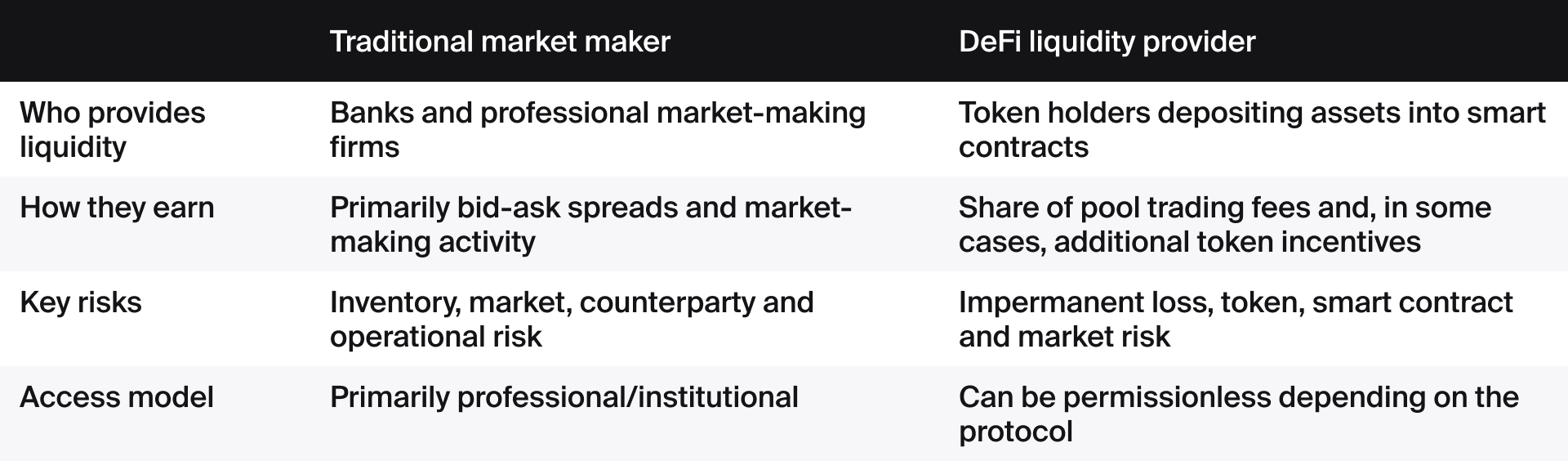
In traditional markets such as forex and equities, liquidity is often supplied by banks and professional market-making firms.
Citigroup, Deutsche Bank and JPMorgan, for example, are major financial institutions that participate in liquidity provision across traditional markets. A market maker typically quotes two prices: a bid and an ask.
The bid is the price at which it is willing to buy an asset. The ask is the price at which it is willing to sell it. Suppose a liquidity provider quotes a currency pair at:
Bid: 1.0849Ask: 1.0851
The difference between the two prices is the bid-ask spread. By continuously offering both sides of the market, liquidity providers allow other participants to trade without waiting for a specific buyer or seller to appear.
The spread can compensate the liquidity provider for supplying that service and taking the risk of holding inventory whose price may change.
This model requires substantial infrastructure, capital and risk management. Traditional liquidity providers also operate within regulatory frameworks that vary by market and jurisdiction, including rules such as MiFID II, Dodd-Frank and Basel III. DeFi reinvented this role by removing the bank and, in many cases, the order book.
What is a liquidity provider in crypto and DeFi?
In DeFi, a liquidity provider typically supplies tokens to a smart contract-based pool that traders can swap against.
Instead of a professional market maker continuously posting bids and asks, an automated market maker (AMM) can determine prices algorithmically based on the assets in its pool.
Consider a simple ETH/USDC pool. Liquidity providers deposit ETH and USDC into the pool. When someone swaps USDC for ETH, they add USDC to the pool and remove ETH. The AMM's pricing formula adjusts the price as the balance between the two assets changes.
The liquidity does not come from a bank. It comes from the assets supplied by LPs. This creates a major structural difference from traditional markets: DeFi liquidity provision can be open to individual wallet holders.
You do not need to operate a market-making desk to supply assets to an AMM pool. If a protocol allows permissionless liquidity provision, a compatible wallet and the required tokens can be enough to participate. That does not mean all crypto liquidity works this way.
Centralized crypto venues can use conventional order books and professional market makers much like traditional financial markets. DeFi AMMs instead use smart contracts and pooled on-chain liquidity.
Different DeFi protocols also structure pools differently. Some use two-token pools. Others support several assets, different asset weights or concentrated liquidity within selected price ranges.
How do liquidity providers make money?
Liquidity providers are compensated for making assets available to traders, but the mechanism depends on the market. In traditional markets, market makers can earn from the spread between the prices at which they buy and sell.
DeFi LPs generally earn a proportional share of fees generated by swaps through their liquidity pool. Suppose a pool contains $10 mln of liquidity and your position represents 1% of that pool. If the protocol distributes trading fees proportionally, you would generally be entitled to 1% of the LP fees generated while your share remains 1%, subject to the pool's specific rules.
The exact fee structure varies by protocol and pool. Some protocols also offer additional token incentives to attract liquidity. This is commonly called liquidity mining. But fees and incentives should never be viewed without considering the other side of the equation.
Providing liquidity can expose you to impermanent loss. When the relative prices of the tokens in an AMM pool change, the composition of your position changes as traders and arbitrageurs interact with it. Your LP position can therefore become worth less than simply holding the original assets.
The relevant question is not just "How much did I earn in fees?" It is: Did those fees compensate for the risks and the difference compared with holding the assets? See Impermanent loss explained for the underlying math and worked examples.
How to evaluate a crypto liquidity provider
"Liquidity provider" can refer to very different businesses, protocols and pools in crypto. Instead of looking for a single "best" provider, evaluate what matters for the specific market you want to access.
Track record
How long has the protocol or provider operated? A longer operating history does not eliminate risk, but it gives you more information about how the system has behaved under different market conditions.
For a DeFi protocol, look at its security history, published audits and any previous incidents. An audit can reduce uncertainty but cannot guarantee that smart contracts are free of vulnerabilities.
Liquidity depth and coverage
Liquidity matters because it directly affects trade execution. A pool with little depth can experience substantial price impact when a large swap occurs. A deeper pool can generally absorb a comparable trade with less movement.
Also consider which assets and blockchain networks are supported. A provider may have deep liquidity for one pair but little or none for another.
Fees and transparency
Understand how fees work before supplying liquidity. What fee does the pool charge traders? How much goes to LPs? Are there additional protocol fees? Are any incentives temporary?
The headline fee percentage alone tells you little without knowing trading activity and the size of the liquidity competing for those fees.
Reliability
Liquidity is only useful when it is accessible. For DeFi, that means considering the reliability of the underlying blockchain, smart contracts and interfaces you use to interact with them. For other crypto liquidity models, operational reliability can involve additional infrastructure.
A useful evaluation therefore looks beyond a provider's name. It examines the depth, economics, risks and technical setup of the liquidity itself.
How to become a liquidity provider
The exact process varies between DeFi protocols, but providing liquidity to an AMM generally follows a few basic steps.
- Connect your wallet. Open the DeFi application you want to use and connect a supported wallet.
- Choose a liquidity pool. Select the token pair or pool you want to provide liquidity to. Check the pool's assets, fee structure and liquidity model before proceeding.
- Supply the required assets. Depending on the pool design, you may need both tokens in a particular ratio or may be able to supply liquidity under different rules.
- Confirm the transaction. Your wallet will show the transaction and applicable network fee before you approve it.
- Receive a representation of your position. Traditional AMMs commonly issue LP tokens representing your share of the pool. Other designs, including concentrated-liquidity systems, can represent positions differently.
Once your liquidity is active, swaps through the pool can generate fees according to the protocol's rules.
You can normally withdraw by removing your liquidity through the same protocol. The assets you receive may not be in the same quantities you originally supplied because trading activity changes the composition of the pool.
Withdrawal can also depend on the protocol's specific rules. Network congestion can increase transaction costs or delays, while some protocols or incentive programs may impose lock periods or other conditions.
Know those rules before depositing assets rather than discovering them when you want to withdraw.
Liquidity aggregators: accessing many liquidity providers at once
A trader faces the opposite side of the liquidity problem. LPs want their capital to be used efficiently. Traders want sufficient liquidity at an efficient price.
But DeFi liquidity is fragmented. The same token pair can have liquidity across different AMMs, pools and blockchain networks. Each source can offer different prices, depth and fees at the same moment.
Choosing one pool therefore means relying on the liquidity available in that pool. A DEX aggregator takes a different approach. It searches across multiple liquidity sources and can determine how to route a swap based on the conditions available at that time.
This is the role of 1inch. Its Pathfinder routing algorithm evaluates available liquidity and can split a swap between different sources when that produces a more efficient route than using a single pool. Consider a token available from two pools.
Pool A has the better starting price but limited depth. Pool B has a slightly worse starting price but substantially more liquidity.
Sending an entire large swap through Pool A could move its price enough to make the overall result worse. A routing algorithm can instead determine whether splitting the trade between A and B produces a better outcome.
Aggregation does not create liquidity. It makes fragmented liquidity easier to access. That distinction is important. Individual LPs still supply the underlying assets. The aggregator searches across those sources so a trader does not have to identify and compare each one manually.
FAQ
What is a liquidity provider?
A liquidity provider supplies assets to a market so other participants can trade. In traditional finance, liquidity providers are typically banks and market-making firms quoting buy and sell prices. In DeFi, LPs can supply tokens to smart contract-based liquidity pools.
How do liquidity providers make money?
Traditional market makers can earn from bid-ask spreads and related market-making activity. DeFi liquidity providers generally receive a share of trading fees generated by their pool and may sometimes receive additional token incentives.
Fee income does not guarantee that providing liquidity will outperform simply holding the assets. LPs also need to account for risks such as impermanent loss.
How do I evaluate a crypto liquidity provider?
Look at its track record, liquidity depth, supported assets and networks, fee structure, transparency and technical reliability. For DeFi pools, also consider smart contract security and the risks of the assets involved.
For a more detailed framework, see the evaluation section above.
How do I become a liquidity provider on a protocol such as Uniswap?
Connect a supported wallet, choose a pool, select the amount and range or other liquidity parameters required by that protocol, then approve the relevant transactions.
The exact process and position structure depend on the AMM. Before providing liquidity, understand the pool's fees, mechanics and exposure to impermanent loss.
Why can't I remove my liquidity from a pool?
The reason depends on the protocol. Possible factors include blockchain congestion, insufficient native tokens to pay network fees, a protocol-specific lock period, an incorrect network or wallet connection, or a temporary problem with the interface.
Check the protocol's rules and the transaction status before assuming the liquidity itself is inaccessible.
For guidance on choosing and assessing pools, see What are crypto liquidity pools? Liquidity providers make markets possible. TradFi relies heavily on professional firms quoting prices, while DeFi has turned liquidity provision into a smart contract-based process that can be open to individual token holders.
For traders, however, the proliferation of liquidity providers creates another challenge: finding the right liquidity source for each swap.
Aggregation addresses that fragmentation by searching across available liquidity instead of forcing you to rely on a single pool.
Access liquidity from hundreds of sources on the 1inch app.
Disclaimer : This content is for general information purposes only and does not constitute financial, investment, tax, or legal advice and is not a recommendation to buy or sell any particular digital asset or to employ any specific investment strategy.
Join us


