Crypto liquidity pools in 2026: categories, yields and how to evaluate them

A crypto liquidity pool is a smart contract-based reserve of tokens that lets traders swap without matching directly with a buyer or seller. But pools differ widely in liquidity, fees, structure and risk, so comparing headline APYs alone tells you very little.
You find two liquidity pools for the same tokens. One shows a much higher APY. The other has more liquidity and trading volume. Which one makes more sense? The answer is not necessarily the one advertising the bigger number.
Evaluating crypto liquidity pools means looking at what generates the fees, how deep and active the pool is, how sustainable its incentives are and what risks you take by depositing your assets.
This guide is not a ranking of "best" crypto liquidity pools. Instead, it gives you a framework for evaluating any pool yourself - from liquidity depth and fee generation to impermanent loss and smart contract risk.
What separates a strong liquidity pool from a weak one
Start with liquidity itself. Total value locked (TVL) shows how much capital is deposited in a pool or protocol. Higher TVL can indicate that a pool has substantial liquidity available, but TVL should never be read in isolation.
A pool can have high TVL and little trading activity. That matters because liquidity providers generally receive fees when traders actually use the pool. Capital sitting in a pool without meaningful trading volume may generate little fee income.
Volume therefore adds important context. Suppose Pool A has $100 mln in TVL and $2 mln in daily trading volume, while Pool B has $20 mln in TVL and $10 mln in daily volume. Pool A is larger, but Pool B has substantially more trading activity relative to its size.
Neither metric alone tells you which pool fits your goals. Together, they tell you much more about how the liquidity is actually being used.
Depth also directly affects traders. A shallow pool can experience significant price impact from a relatively large swap. A deeper pool can generally absorb the same trade with less movement.
That comes from the mechanics of automated market makers (AMMs). As a trader removes one token and adds another, the balance of the pool changes and the AMM adjusts the price. The larger the trade relative to the available liquidity, the greater the potential price impact.
For the underlying mechanics, see How automated market makers work. When evaluating a pool, look at TVL, trading volume and depth together. TVL tells you how much capital is there. Volume tells you whether traders use it. Depth tells you how well that liquidity can absorb trades.
How liquidity providers actually participate
Liquidity providers supply the assets that traders use when swapping through AMMs. In a traditional two-token pool, you deposit both assets according to the pool's rules. In return, many AMMs issue LP tokens representing your proportional share of the pool.
If you own 1% of the pool, you generally have a claim on 1% of its underlying assets and the LP fees allocated to that share, subject to the protocol's specific mechanics.
Not every modern pool uses conventional fungible LP tokens. Concentrated-liquidity designs, for example, can represent individual positions differently because each LP can choose a specific price range.
The pair you select matters as much as the pool itself. If the relative prices of the two assets change, AMM activity changes the composition of your position. That can create impermanent loss compared with simply holding the assets.
For the formula and worked examples, see Impermanent loss explained. Pool design also affects capital efficiency. Some AMMs spread liquidity across the entire price curve. Others concentrate liquidity around selected prices. Concentrating liquidity can put more of an LP's capital to work around the current market price, potentially generating more fees per dollar of capital while the price stays within the selected range.
But greater capital efficiency can come with different risks. If the market moves outside a concentrated range, the position can stop generating swap fees and become entirely composed of one asset. So before comparing fee rates, understand what your capital will actually be doing inside the pool.
Pool structures you'll actually encounter
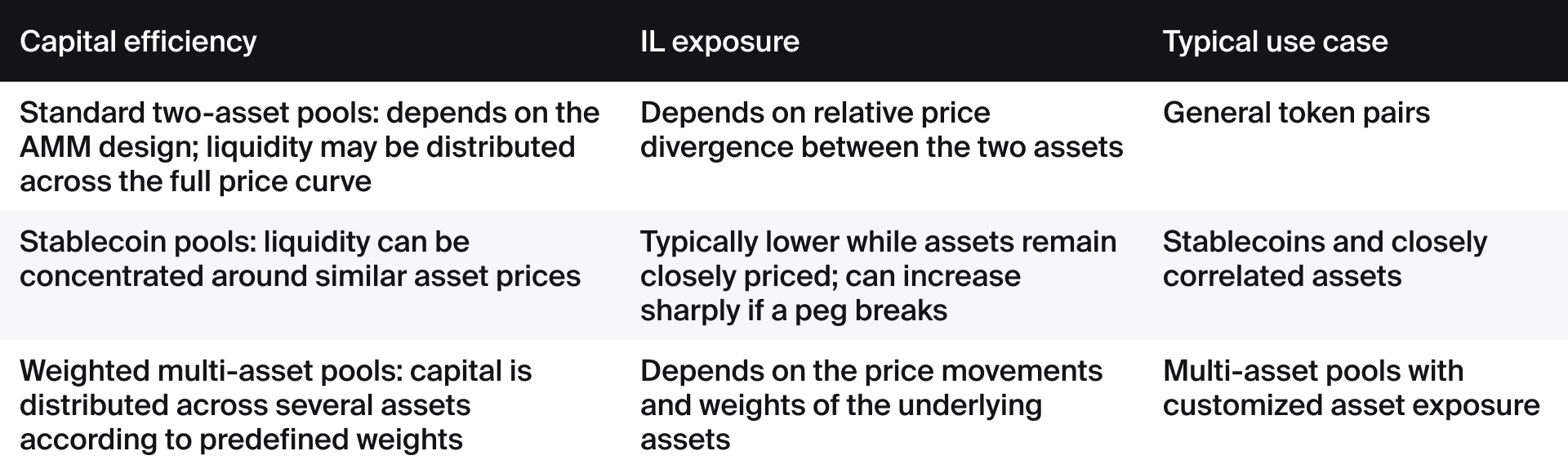
Crypto liquidity pools use different structures for different markets. Three common models illustrate how much the mechanics can vary.
Standard two-asset AMM pools
The classic model contains two assets and prices them according to an AMM formula. In a constant-product pool, for example, the relationship between the reserves follows x × y = k. Trading changes the ratio of the assets and therefore changes the price.
This structure can support many token pairs, but LPs are exposed to price divergence between the two assets.
Stablecoin pools
Pools designed for stablecoins or other closely priced assets can use curves optimized around a narrow expected price relationship.
Because the assets are intended to remain close in value, their relative prices may diverge less under normal conditions. That can reduce impermanent-loss exposure compared with pairs whose prices move independently. It does not remove risk. A stablecoin losing its peg can create substantial divergence.
Multi-asset weighted pools
Some pools contain more than two assets and assign different weights to each. Balancer is an example of an AMM architecture supporting weighted multi-asset pools. A pool might hold several assets at predefined proportions rather than maintaining a conventional 50/50 two-token structure.
That changes both the pool's pricing mechanics and the LP's exposure to the underlying assets.
No structure is universally preferable. The relevant question is whether the mechanics match the assets, market conditions and risk you are prepared to take.
Categories of platforms hosting liquidity pools
Different DeFi protocols use liquidity pools for different purposes. Looking at a few factual examples shows why comparing pool structures matters more than comparing brand names.
Balancer supports AMM pools that can contain multiple assets with configurable weights. This creates pool structures beyond the conventional 50/50 token pair.
Compound uses pooled liquidity in a lending model. Suppliers provide assets that borrowers can access according to the protocol's rules. This differs from an AMM pool designed primarily for swaps.
Curve Finance uses AMM designs optimized for assets expected to trade at similar prices, including stablecoins and other closely correlated assets.
These examples belong to different categories, so their headline metrics are not directly comparable.
When evaluating any platform, consider the same underlying questions. What fees does the pool generate? What drives those fees? How much liquidity does it hold? How consistent is its volume? What risks come from its smart contracts and assets? Has its code been audited? How long has the system operated? APY only becomes meaningful once you understand what produces it.
How fees and APY actually work
A high APY can look attractive. But first ask where it comes from. For an AMM pool, traders generally pay a fee when swapping. Some or all of that fee can be distributed among LPs according to the protocol's rules.
Suppose a pool charges a 0.3% swap fee. That does not mean LPs automatically earn 0.3% on their liquidity. It means each eligible swap generates a fee based on the traded amount. The LP's share depends on factors including total trading volume, the amount of liquidity competing for those fees and the protocol's fee distribution.
A pool with high volume relative to its liquidity can generate more fees per dollar of LP capital than a much larger but rarely used pool.
APY attempts to annualize the rate at which a position generates compensation. But not every displayed APY comes from the same source.
One pool may derive most of its APY from trading fees. Another may add token incentives on top. Those are economically different.
An incentive program can temporarily increase the displayed APY by distributing newly issued or allocated tokens to LPs. If the incentive changes or ends, the APY can fall even if trading activity remains unchanged.
The market value of reward tokens can also change. So when you see an unusually high advertised APY, break it down:
- How much comes from actual trading fees?
- How much comes from token incentives?
- How consistent is the pool's trading volume?
- How long are the incentives scheduled to continue?
- What risks are you taking in the underlying token pair?
The headline percentage is the beginning of the analysis, not the conclusion.
Liquidity mining and yield farming, briefly
Liquidity mining adds token incentives to the compensation LPs receive from a pool.
A protocol may distribute tokens to encourage users to supply liquidity. This can help attract capital to a new or strategically important pool.
The additional tokens can increase the position's displayed APY while the incentive program is active. But the incentive does not change the underlying economics of the pool: trading activity, impermanent loss and smart contract risk still matter.
Yield farming takes this idea further by moving or deploying assets across DeFi protocols to capture multiple layers of incentives.
That introduces additional complexity and dependencies. Each extra protocol or smart contract can add another source of risk.
A full breakdown of yield farming strategies deserves its own guide. For evaluating a liquidity pool, the important distinction is simpler: separate compensation generated by genuine pool activity from temporary token incentives.
A practical framework for evaluating any liquidity pool
You do not need a ranked list to assess a pool. You need a repeatable checklist.
1. Compare TVL with volume
TVL shows how much capital is deposited. Volume shows how actively that capital is being used.
Look at both, preferably over time rather than at a single moment. A temporary volume spike can distort the picture just as easily as a temporary increase in TVL.
2. Break down the APY
Find out what is generating the advertised percentage.
Fee-based compensation supported by sustained trading activity is different from an APY dominated by temporary token incentives.
If the displayed APY depends heavily on incentives, consider what happens when those incentives decline or stop.
3. Examine the pair
The assets determine much of your economic exposure. A stablecoin pair behaves differently from an ETH/stablecoin pool or a pair containing a small-cap token. Consider volatility, correlation and the possibility that one asset could lose substantial value. For detailed impermanent-loss mechanics, see Impermanent loss explained.
4. Understand the pool structure
Is it a standard two-asset AMM? A concentrated-liquidity position? A stablecoin-optimized pool? A multi-asset pool? The answer affects how your capital is allocated and what happens when prices move.
5. Check security history
Look for published smart contract audits and understand what they covered. An audit is evidence that specialists reviewed a particular version and scope of the code. It is not proof that a protocol cannot be exploited. Also check the protocol's operating history and any previous security incidents.
6. Understand your exit
Know how you remove liquidity before you add it. Check whether there are lock periods, network requirements or other pool-specific conditions. Also consider what assets you could receive when exiting. AMM activity may leave your position with a very different token composition from the one you initially deposited. A strong headline APY does not compensate for risks you did not understand.
The risks nobody's yield chart shows you
A pool dashboard can show TVL, fees and APY. It cannot reduce the risks behind those numbers to a single percentage.
Impermanent loss is one of the main AMM-specific risks. If the relative prices of the pooled assets diverge, your LP position can become worth less than simply holding those assets. The complete mechanics are covered in the impermanent loss guide.
Smart contract risk is separate. A bug or unexpected interaction can result in losses even if the economics of the pool work exactly as expected.
Audits matter because they can identify vulnerabilities before deployment or after major changes. But audited does not mean risk-free. Check who performed the audit, what code was reviewed, when it was reviewed and whether the deployed contracts correspond to the reviewed version.
Asset risk matters too. A pool cannot protect you from an underlying token collapsing in value. Stablecoin pools can also become highly asymmetric if one asset loses its peg.
Concentration risk can arise when too much of your DeFi exposure depends on one pool, protocol or token pair.
Spreading capital across pools can reduce some concentration risks, but it also increases complexity and can expose you to more smart contracts. Risk management therefore involves trade-offs rather than a formula that removes risk altogether.
Entry and exit timing also matter. Market conditions can change quickly, and liquidity available when you enter a position may look very different when you want to leave.
FAQ
How risky are liquidity pools?
Liquidity pools can expose you to impermanent loss, smart contract vulnerabilities, token price movements and, depending on the pool, additional risks such as stablecoin depegging or concentrated-liquidity ranges.
The level and type of risk depend on the assets, pool structure and protocol. Audits and an established operating history can provide useful information but do not eliminate risk.
How do I evaluate which liquidity pool is right for me?
Start with TVL and trading volume, then examine the source and sustainability of the displayed APY. Check the underlying token pair, pool structure, smart contract security history and how withdrawals work.
The relevant pool depends on your own objectives and risk tolerance rather than a universal ranking.
How do I evaluate a liquidity provider?
Look at the liquidity provider or protocol's track record, available liquidity depth, supported assets, fee structure, transparency and security history.
If you are assessing an individual pool, also consider how much of its compensation comes from trading activity versus temporary token incentives.
For a deeper look at the role itself, see What is a liquidity provider? Crypto liquidity pools can look easy to compare when each one presents a TVL and APY. In practice, those numbers describe only part of the position.
The more useful questions are where the compensation comes from, whether trading volume is sustainable, how the pool structure changes your exposure and which risks sit behind the headline percentage.
For traders, the large number of pools creates a different problem: liquidity is fragmented across them. A DEX aggregator searches across multiple liquidity sources instead of making you check pools one by one.
Interact with liquidity across every major pool on the 1inch app.
Disclaimer : This content is for general information purposes only and does not constitute financial, investment, tax, or legal advice and is not a recommendation to buy or sell any particular digital asset or to employ any specific investment strategy.
Join us


