Impermanent loss explained: the DeFi math that quietly costs LPs real mone


Impermanent loss is the difference between the value of holding tokens in your wallet and providing those same tokens as liquidity in an automated market maker (AMM). Comparing a liquidity position against simply holding the same assets reveals whether the position is truly profitable.
A positive balance or accumulated trading fees on a pool dashboard does not guarantee an overall gain.
Your liquidity position is up. You have collected trading fees. The pool dashboard shows a positive number. But would you have been better off simply keeping the tokens in your wallet? That is the question impermanent loss answers.
For liquidity providers, the headline number on a position does not tell the whole story. What matters is the result compared with the alternative: holding the same assets without putting them into a liquidity pool.
The math is predictable. Once you understand it, you can estimate how much price divergence could cost you, decide which pairs fit your risk tolerance and judge whether fees and other rewards are enough to compensate.
Core Applications of Impermanent Loss Math
- Estimating divergence costs: Liquidity providers can calculate in advance how much price divergence between pooled tokens will reduce their position value.
- Selecting asset pairs: Liquidity providers can choose token pairs that match their individual risk tolerance by analyzing price divergence scenarios.
- Evaluating fee compensation: Liquidity providers can determine whether collected swap fees and protocol rewards are large enough to offset their divergence losses.
What is impermanent loss, really?
Impermanent loss is the opportunity cost that can arise when you provide liquidity to an AMM instead of simply holding the same assets.
Suppose you have $1,000 worth of two tokens. You can keep them in your wallet, or you can deposit them into a liquidity pool.
If the relative price between those tokens changes, an AMM automatically changes the quantities of each asset in your position. Arbitrage traders help bring the pool price back in line with the wider market by buying one asset from the pool and adding the other.
As a result, when you compare your liquidity position with the tokens you would have held, the pool position can be worth less.
A useful term for this is divergence loss. The loss comes from the prices of the two assets diverging from the ratio at which you originally supplied them. The greater that divergence, the larger the potential difference between providing liquidity and holding.
Divergence Loss Characteristics
- Alternative naming: Divergence loss is an alternative term for impermanent loss.
- Origin of the loss: Divergence loss occurs when the prices of two assets separate from the ratio at which they were originally supplied.
- Impact of price divergence: Greater price divergence between two pooled assets creates a larger potential value difference between providing liquidity and holding.
Realizing Versus Eliminating the Loss
- Reversing the loss: Impermanent loss can disappear if relative token prices return to their original ratio before a withdrawal occurs.
- Locking in the loss: Withdrawing tokens while relative prices remain diverged locks in the difference in value permanently.
- Dollar gains with impermanent loss: A liquidity position can rise in overall dollar value while still suffering impermanent loss.
- The holding benchmark: Impermanent loss occurs whenever simply holding original tokens produces a higher value than maintaining the liquidity pool position.
"Impermanent" can therefore be misleading. If the relative prices return to their original ratio before you withdraw, the loss can disappear. But if you withdraw while the prices remain diverged, the difference is locked in.
Impermanent loss does not necessarily mean your position has lost money in dollar terms. Your liquidity position can rise in value and still suffer impermanent loss if simply holding the original tokens would have produced a higher value. That distinction is crucial.
Why impermanent loss happens
Impermanent loss is a consequence of how AMMs keep their internal prices aligned with the wider market. Consider a basic constant-product AMM. It maintains the relationship:
x × y = k
Here, x and y are the quantities of the two tokens in the pool and k remains constant, ignoring fees and liquidity changes.
Suppose an ETH/USDC pool starts with ETH priced at $2,000. Then the external market price of ETH rises to $4,000.
The AMM does not receive an external price update and simply change its displayed ETH price. Its price comes from the ratio of assets inside the pool.
That creates an arbitrage opportunity. While ETH remains cheaper in the pool than elsewhere, arbitrage traders can buy ETH from the pool and add USDC. As ETH leaves and USDC enters, the ratio changes until the pool price approaches the external market price.
The liquidity provider is left with less of the asset that increased in relative value and more of the other asset.
The Arbitrage Rebalancing Mechanism
- Price discrepancy: A divergence between external market prices and pool asset ratios creates an arbitrage opportunity.
- Arbitrage execution: Arbitrage traders purchase the cheaper asset from the pool and add the other asset until the pool price approaches the external market price.
- Asset reallocation: Arbitrage trading leaves liquidity providers with less of the asset that increased in relative value and more of the other asset.
Liquidity Provision Versus Holding
- Hold strategy asset retention: An investor who holds tokens outside a pool retains the full original amount of both assets.
- Pool selling mechanism: An automated market maker liquidity position becomes worth less than a holding strategy because the pool automatically sells the asset rising in relative value.
- Directional neutrality: Relative price divergence causes impermanent loss regardless of whether an asset price moves upward or downward.
- Divergence scale: Greater distance between the current relative price and the starting price ratio increases the total divergence loss.
If the LP had simply held the original tokens, they would still own the original amount of ETH. Because the AMM sold some ETH as its price rose, the LP's position is worth less than the hold strategy.
The same principle applies in the other direction. Impermanent loss is caused by price divergence, not by whether a token goes up or down.
The further the relative price moves from its starting point, the larger the divergence loss becomes. For more on the underlying mechanism, see Automated market makers explained.
The impermanent loss formula
For a standard 50/50 constant-product AMM, impermanent loss can be calculated using:
IL = (2 × √r / (1 + r)) − 1
Here:
IL = impermanent loss relative to holding r = the new price divided by the original price
Suppose one asset doubles relative to the other. The price ratio is therefore:
r = 2
Put that into the formula:
IL = (2 × √2 / 3) − 1
The result is approximately:
−5.72%
That does not mean your entire position fell 5.72% in dollar terms.
It means your liquidity position is worth approximately 5.72% less than the value you would have had by simply holding the original assets, before accounting for trading fees or other rewards.
Here is what different levels of price divergence look like:
Price divergence | IL percentage | Equivalent loss on a $1,000 portfolio |
1.25x | 0.62% | $6.19 |
1.5x | 2.02% | $20.20 |
2x | 5.72% | $57.19 |
5x | 25.46% | $254.64 |
The relationship is not linear. A 25% price move produces relatively little impermanent loss. But as the two assets move further apart, the effect becomes much larger.
A fivefold divergence creates an impermanent loss of roughly 25.5% relative to holding.
The formula is also symmetrical in economic terms. If one asset rises fivefold relative to the other, or the other asset rises fivefold relative to the first, what matters is the magnitude of the relative price divergence.
An impermanent loss calculator essentially applies this formula for you. But understanding the formula matters because it shows exactly what drives the risk: not simply volatility, but relative price movement between the assets in your pool.
Does asset pair choice change your risk?
Yes. The relationship between the two assets is one of the biggest factors determining your exposure to impermanent loss.
Assets whose prices tend to move together generally create less divergence than assets that behave very differently.
Stablecoin pools illustrate the principle. If two assets both remain close to the same reference value, their relative price should stay near the starting ratio. That can keep impermanent loss low.
But "stable" does not mean risk-free. A stablecoin can deviate from its peg, and if that divergence becomes significant or permanent, an LP can still face substantial losses.
At the other end of the spectrum are pairs containing two volatile assets whose prices can move independently. An ETH/small-cap-token pool, for example, can experience large relative price changes if one asset rises or falls much faster than the other.
The important question is therefore not simply, "Are these assets volatile?" It is: How likely are they to diverge from each other? Two volatile assets that move closely together can produce less impermanent loss than a pair in which one asset remains stable while the other moves sharply.
Pair selection does not eliminate impermanent loss. It changes the probability and potential magnitude of the divergence that causes it.
Paper loss vs. realized loss
Impermanent loss changes as relative asset prices move. That is why the word "impermanent" exists in the first place.
Suppose you enter a liquidity pool when two assets have a particular price ratio. The ratio later changes, producing a 5% impermanent loss relative to holding.
If you keep the position open and the assets eventually return to their original relative price, that divergence loss can disappear.
If you withdraw while the 5% divergence still exists, however, you receive the pool's current asset composition. At that point, the difference compared with holding has effectively been realized.
For an LP, the decision can be framed as a continuing comparison:
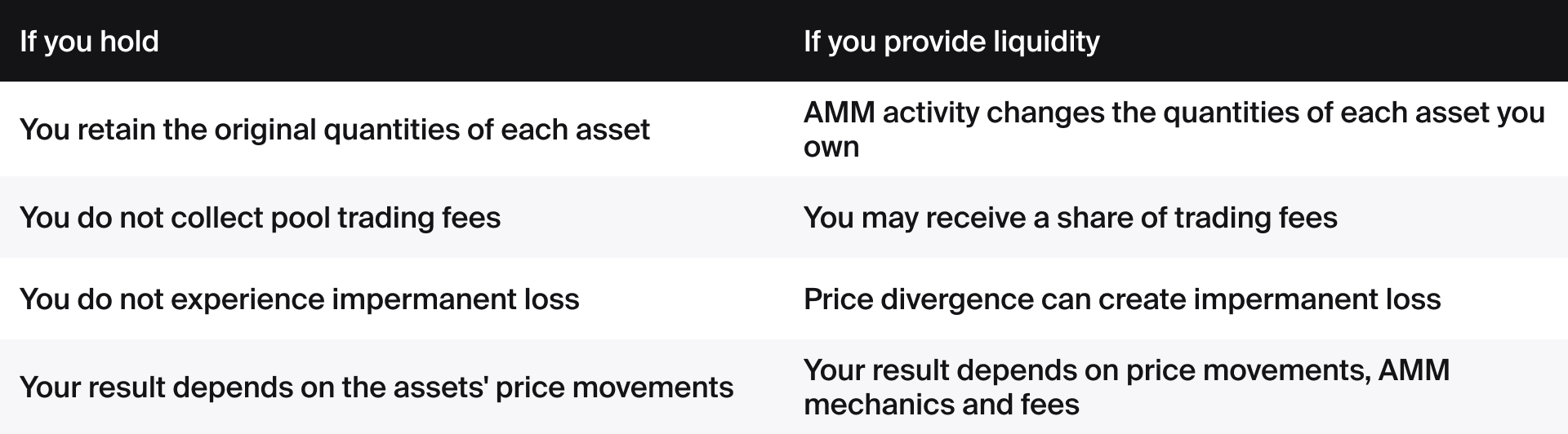
Time horizon therefore matters. A temporary divergence may reverse. A lasting divergence may not. And waiting for prices to return to their original ratio carries its own market risk: there is no guarantee that they ever will.
The practical question is not simply whether your position currently shows impermanent loss. It is whether the total economics of keeping the position open still make sense relative to your alternatives.
How to reduce your impermanent loss exposure
You cannot remove the mathematical possibility of impermanent loss from a conventional AMM position. But you can change your exposure and consider whether the compensation you receive is sufficient.
Choose assets that are less likely to diverge
Correlated pairs generally reduce the chance of large relative price movements. Stablecoin pairs are the clearest example. If both assets remain close to their intended pegs, the relative price movement should be limited.
The trade-off is that lower divergence risk does not automatically make a liquidity position attractive. Fees, pool activity and other risks still matter.
Compare trading fees with divergence loss
Trading fees are the primary mechanism that can compensate LPs for impermanent loss. Every time traders use a pool, a portion of the fees can accrue to liquidity providers according to the protocol's rules. That means impermanent loss should not be considered in isolation.
Imagine your position experiences 3% impermanent loss relative to holding but accumulates fees equivalent to 5% of the position's starting value over the same period. Other things being equal, the fees have more than offset the divergence loss.
If the position accumulates only 1% in fees, they have not. The relevant comparison is therefore between the cost created by divergence and the compensation generated by providing liquidity.
High trading volume can increase fee generation, but past activity does not guarantee future fees. And a sudden large price divergence can outweigh fees accumulated over a much longer period.
Consider your timing
Impermanent loss depends on the price ratio when you enter and when you assess or close the position.
Entering immediately before a major divergence can expose the position to significant IL quickly. A more stable relative price can produce a very different outcome.
This does not mean you can reliably predict the market. It means the current relationship between the assets and the possibility of future divergence belong in your decision.
Understand concentrated liquidity
Concentrated liquidity allows LPs to provide assets within selected price ranges instead of distributing liquidity across the entire price curve.
A narrower range can make capital more efficient and potentially generate more fees for a given amount of liquidity while the market remains inside that range.
But concentration changes the risk. If the price moves through or outside your chosen range, the composition of your position can change substantially and the position can become entirely concentrated in one asset. Narrower ranges therefore require closer attention to price movement and can increase exposure to divergence.
Uniswap v3 is a well-known example of this model. This is a different liquidity structure, not a way to make impermanent loss disappear.
Understand protocol-specific protection mechanisms
Some protocols have experimented with mechanisms intended to compensate LPs for impermanent loss under specified conditions.
Bancor, for example, has used protocol-level impermanent-loss protection mechanisms in previous designs.
Such mechanisms add their own rules, dependencies and risks. They should be evaluated as part of the specific protocol rather than treated as a general solution to impermanent loss.
Is impermanent loss worth the risk?
There is no universal answer. What matters is the net outcome. A simple way to think about an LP position is:
Net outcome = fee income + rewards − impermanent loss
That framework is more useful than looking at any component separately.
A pool can generate substantial fees and still leave you worse off than holding if price divergence is large enough. Conversely, modest impermanent loss can be outweighed by sufficient fees.
You also need to consider risks that are not captured by the formula: smart contract risk, token risk and the possibility that an asset permanently loses value or a stablecoin loses its peg.
The key benchmark is the alternative. Ask: What would my position be worth if I had simply held the same assets? Then compare that with the current value of your LP position plus the fees and any other rewards you have actually earned.
LPs cannot control how far two market prices eventually diverge. But they can control some other costs associated with their DeFi activity, including how they swap assets when entering, adjusting or exiting positions.
A DEX aggregator can search liquidity across multiple sources rather than relying on a single pool. The 1inch app uses aggregation to find efficient swap routes across available liquidity.
Intent-based swaps powered by 1inch Fusion can also help protect swaps from MEV and remove the need for the user to pay network gas for the swap itself. For an LP already managing unavoidable risks such as price divergence, reducing avoidable execution costs can matter to the overall result.
FAQ
What is impermanent loss in cryptocurrency?
Impermanent loss is the difference between the value of assets supplied to an AMM liquidity pool and the value those same assets would have had if you had simply held them. It occurs when the relative prices of the pooled assets diverge.
Is a liquidity pool profitable?
It can be, but profitability depends on the complete outcome. Trading fees and other rewards need to be compared with impermanent loss and other risks. A pool generating fees does not automatically mean an LP is better off than holding the underlying assets.
How do I make money with liquidity pools despite impermanent loss?
LPs receive compensation such as trading fees and, in some protocols, additional rewards. Whether these outweigh impermanent loss depends on trading activity, fee structure, price divergence and the time the position remains active.
Staking vs. providing liquidity: which has more risk?
They involve different risks. Providing liquidity to an AMM can expose you to impermanent loss because the relative prices of pooled assets can change. Staking does not generally create the same AMM-based divergence loss, but it can involve other risks depending on the asset, network and staking mechanism.
How do concentrated liquidity ranges affect impermanent loss?
Concentrated liquidity places an LP's capital within a selected price range. Narrow ranges can increase capital efficiency and fee generation while the price remains within the range, but they can also increase exposure to changes in asset composition as the price moves. If the price leaves the range, the position can end up entirely in one asset.
Can impermanent loss go away on its own?
Yes, if the relative price of the pooled assets returns to the ratio at which you entered the position. But there is no guarantee that prices will return. If you withdraw while prices remain diverged, the loss relative to holding is locked in.
Do stablecoin pools have impermanent loss?
Yes, although it can be small while both assets remain close to their pegs. If one stablecoin deviates substantially from its expected value, the relative price can diverge and impermanent loss can become significant.
Impermanent loss is not an obscure edge case. It is built into the mechanics of AMM liquidity provision. Understanding the formula lets you evaluate the trade-off before committing your assets rather than discovering it after you withdraw.
Explore 1inch DeFi Academy and start learning today.
Disclaimer: This content is for general information purposes only and does not constitute financial, investment, tax, or legal advice and is not a recommendation to buy or sell any particular digital asset or to employ any specific investment strategy.
Join us


