How to start a career in DeFi: Your first steps into Web3


Want to work in decentralized finance but don't know where to begin? You don't necessarily need to be a blockchain developer or have years of crypto experience. Here's how to build the skills, experience and connections that can help you launch a career in DeFi.
You follow crypto, understand the basics of blockchain and find decentralized finance interesting. But how do you turn that interest into an actual job?
For newcomers, DeFi can seem difficult to break into. Job descriptions are full of unfamiliar terms, projects move quickly and many people working in the industry appear to have been involved since its earliest days.
The good news is that DeFi needs more than smart contract developers. As the industry grows, it also needs designers, analysts, marketers, content creators, business development specialists and people with experience in traditional finance.
Getting started is less about knowing everything and more about finding where your existing skills fit, learning the fundamentals and becoming part of the community.
What kinds of jobs are available in DeFi?
DeFi is a broad ecosystem of protocols, wallets, infrastructure providers and applications that enable financial activity through blockchain networks and smart contracts.
That creates opportunities across a wide range of professions.
Software engineers develop smart contracts, build applications and work on blockchain infrastructure. Security researchers examine code for vulnerabilities and help projects reduce technical risks.
But technical roles are only part of the picture.
Product managers help teams turn complex technologies into services people can use. Designers build interfaces that make DeFi applications easier to understand. Data analysts study blockchain activity, liquidity and user behavior.
Content specialists explain products and concepts. Community managers engage with users, while business development teams establish relationships with other projects and potential partners.
Legal, compliance and operations specialists also have roles to play, particularly as DeFi infrastructure becomes more connected to traditional financial services.
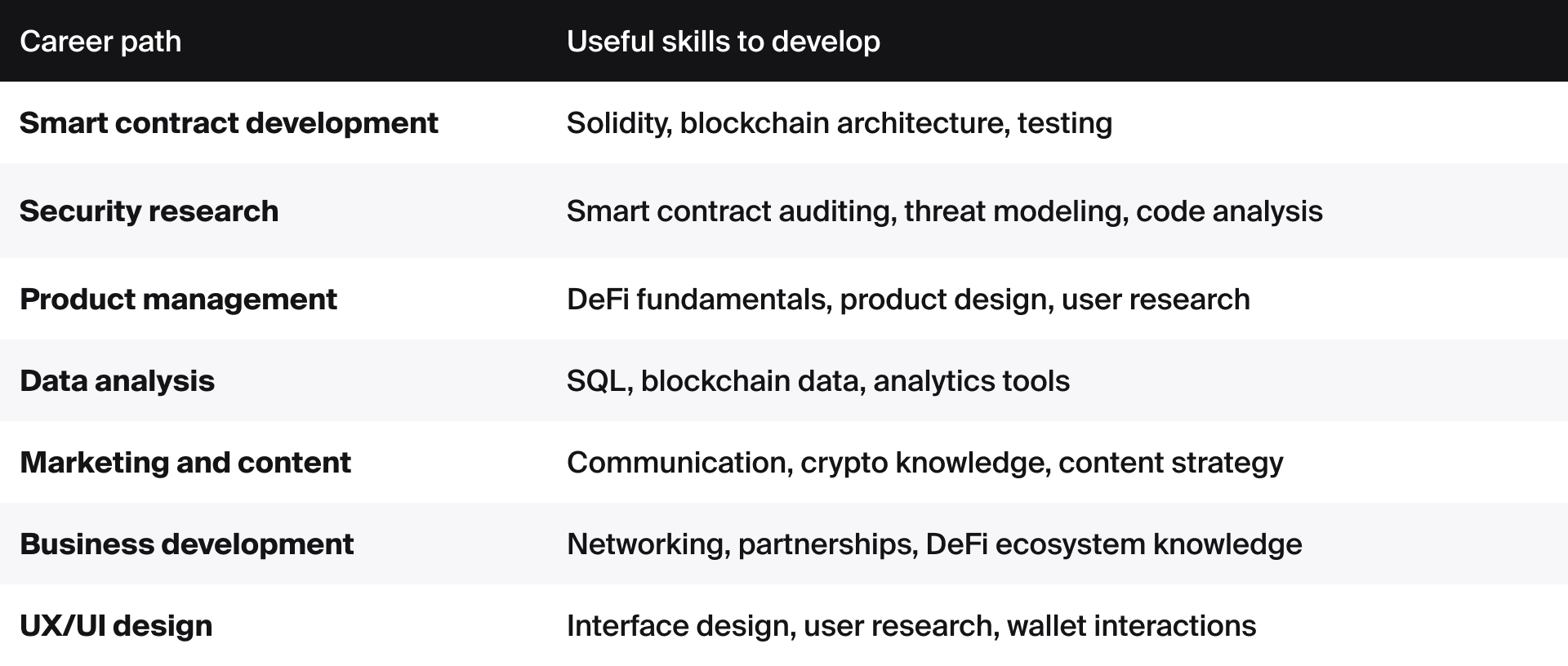
You don't need to choose a specialization immediately. But identifying one or two areas that match your strengths makes it easier to decide what to learn next.
Learn how DeFi actually works
Before applying for jobs, you need a working understanding of the technology and the problems it solves.
Start with the fundamentals: what blockchains are, how wallets work, what smart contracts do and why decentralization matters.
Then move to the main building blocks of DeFi.
Learn how decentralized exchanges and swap aggregators work. Understand liquidity pools, automated market makers (AMMs), lending protocols, stablecoins and transaction fees.
You should also understand the risks. Smart contract vulnerabilities, phishing, malicious approvals, liquidation and market volatility are part of the environment in which DeFi products operate.
The goal is not to become an expert in every protocol. It is to understand enough to follow industry discussions, evaluate products and recognize where your skills could be useful.
The DeFi Academy on 1inch’s blog offers guides to DeFi concepts, blockchain technologies and the infrastructure behind decentralized trading.
Get hands-on experience
Reading about DeFi is useful. Actually using the technology gives you a different perspective.
Set up a self-custodial wallet and learn how to manage it securely. Explore a blockchain explorer to understand how transactions are recorded and how smart contracts interact.
You can also experiment with DeFi applications using small amounts you can afford to lose, or use testnets and simulations where available.
For example, exploring the 1inch dApp can help you understand how token swaps work, how routes are presented and what users need to consider before confirming a transaction.
Pay attention to the details. What information does the interface provide? Which parts are confusing? What happens when network fees increase? How are transaction risks explained?
These observations can be valuable even if you don't write code.
A prospective product manager might identify opportunities to improve a user journey. A designer might propose a clearer interface. A content specialist could write a guide explaining a complicated feature.
Practical experience helps turn abstract knowledge into something you can demonstrate.
Build something you can show
One of the most useful ways to prepare for a DeFi career is to create a small portfolio of relevant work.
For developers, that could mean building a simple application, contributing to an open-source project or experimenting with smart contracts in a test environment.
For data analysts, it might mean creating a dashboard that tracks activity on a blockchain or compares liquidity across protocols.
For content specialists, it could be a series of articles explaining DeFi concepts. Designers could redesign a wallet interface and explain the decisions behind it.
Your first project doesn't have to be particularly ambitious. A clear, well-executed piece of work can demonstrate your understanding and initiative.
Public contributions are especially useful in an industry where much of the technology is open source and professional discussions happen online.
A GitHub repository, published article, research dashboard or design portfolio gives potential employers something concrete to evaluate.
It also gives you a reason to approach people working in the industry.
Become part of the DeFi community
DeFi is built around networks of developers, researchers, users and businesses. Professional connections are therefore an important part of finding opportunities.
Start by following projects that interest you. Read their documentation, join public community discussions and pay attention to the problems their teams are trying to solve.
GitHub, Discord, Telegram and X are common places for DeFi communities to exchange ideas. Different projects use different channels, so check their official websites before joining.
Try to contribute rather than simply asking for a job.
You might help answer a question, report a documentation issue, share useful research or provide constructive feedback on a product.
Over time, these contributions can help you build relationships and develop a reputation for understanding a particular area.
In-person events can accelerate that process.
Major crypto conferences bring together large parts of the industry, but smaller workshops, hackathons and networking gatherings may be more approachable for newcomers.
Events such as Groundwork, scheduled to run on October 16, can be a starting point for exploring the industry and making connections.
You don't need to arrive with a polished business pitch. Ask people what they're building, what challenges they're facing and how they entered the industry themselves.
A useful conversation can teach you more about a potential career path than dozens of job descriptions.
Look for entry points, not just job openings
Traditional job searches usually begin with a list of vacancies. In DeFi, that is only one possible route.
Some teams recruit through conventional hiring processes. Others discover contributors through open-source development, community participation, hackathons and professional referrals.
That means there are several ways to gain experience before securing a full-time role.
You could contribute to an open-source project, participate in a hackathon, complete a research assignment or help a community improve its documentation.
Freelance work can also provide an entry point for people with existing skills in design, writing, marketing or software development.
When applying, focus on the specific problems you can help solve.
Instead of simply saying that you're passionate about crypto, explain what you've learned, what you've built and how your experience relates to the project.
If you're moving from another industry, highlight transferable skills. Experience in financial services, cybersecurity, software development, journalism or business operations can be relevant to DeFi.
You don't necessarily need to start your professional career from scratch.
Understand what makes working in DeFi different
DeFi offers opportunities, but it also comes with challenges that prospective employees should understand.
Many teams operate remotely and across time zones. Communication is often asynchronous, and employees may need to work independently.
Products and technical requirements can change quickly. Learning is therefore a continuous part of the job.
The industry also includes projects at very different stages of maturity, from established infrastructure providers to experimental startups.
Before accepting a position, research the organization. Understand its product, funding, team structure and business model.
Pay particular attention to compensation arrangements. Some crypto companies offer part of their compensation in tokens, which may be volatile or subject to vesting conditions and taxed differently from cash depending on where you live.
Security matters too. Fake recruiters, malicious links and fraudulent job offers are risks in the crypto industry. Verify that a recruiter represents the organization and never share wallet recovery phrases or private keys.
Working in DeFi can be rewarding, but choosing the right project matters as much as getting your first offer.
A practical plan for your first 30 days
You don't need to master the entire DeFi ecosystem before taking action. A month of focused learning and practical work can help you identify a direction.
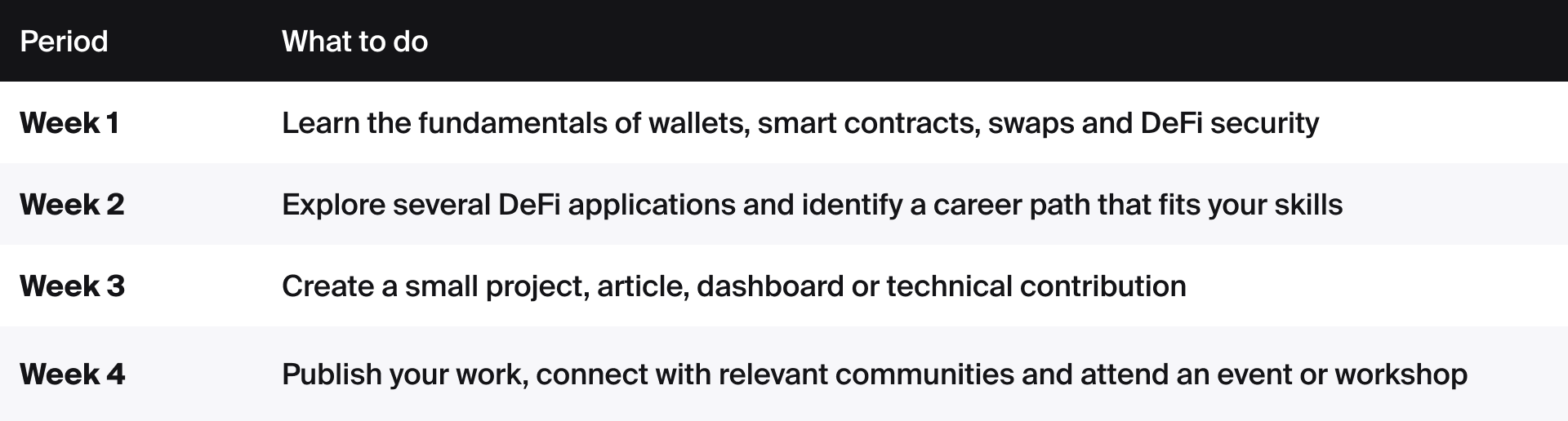
By the end of the month, you should have a clearer understanding of the industry, at least one piece of work to show and a better idea of which roles interest you.
That is a more useful starting point than applying to dozens of positions without knowing what they involve.
Your DeFi career starts with participation
There is no single route into decentralized finance. Some people begin as developers. Others arrive from traditional finance, marketing, design or entirely different industries. What they have in common is a willingness to learn, experiment and contribute.
Start with the fundamentals. Use the technology. Build something useful. Meet people who are already working in the ecosystem.
FAQ
Do I need coding skills to work in DeFi?
No. Coding is essential for many engineering and smart contract security roles, but DeFi companies also hire people in product management, design, marketing, content, operations and business development.
Can I get a DeFi job without crypto experience?
Yes, although you will need to demonstrate an understanding of the industry. Relevant experience from other sectors, combined with practical DeFi knowledge and a portfolio, can help you make the transition.
What programming language should I learn for DeFi?
Solidity is widely used for smart contracts on Ethereum and other EVM-compatible networks. JavaScript and TypeScript are useful for building blockchain applications, while Python is commonly used for data analysis and automation. The best choice depends on the role you want.
Where can I find DeFi career opportunities?
Check the official careers pages of DeFi projects, specialized Web3 job boards, open-source communities and professional networks. Hackathons and industry events can also help you discover opportunities that aren't widely advertised.
How long does it take to start a career in DeFi?
There is no fixed timeline. Someone with relevant software development, finance or marketing experience may be able to transition relatively quickly. A complete beginner will generally need more time to develop the necessary skills and practical understanding.
To explore more DeFi concepts, technologies and industry developments, subscribe to our newsletter.
Disclaimer: This content is for general information purposes only and does not constitute financial, investment, tax, or legal advice and is not a recommendation to buy or sell any particular digital asset or to employ any specific investment strategy.
Join us


