$500 mln in swaps: 1inch Aqua’s new milestone
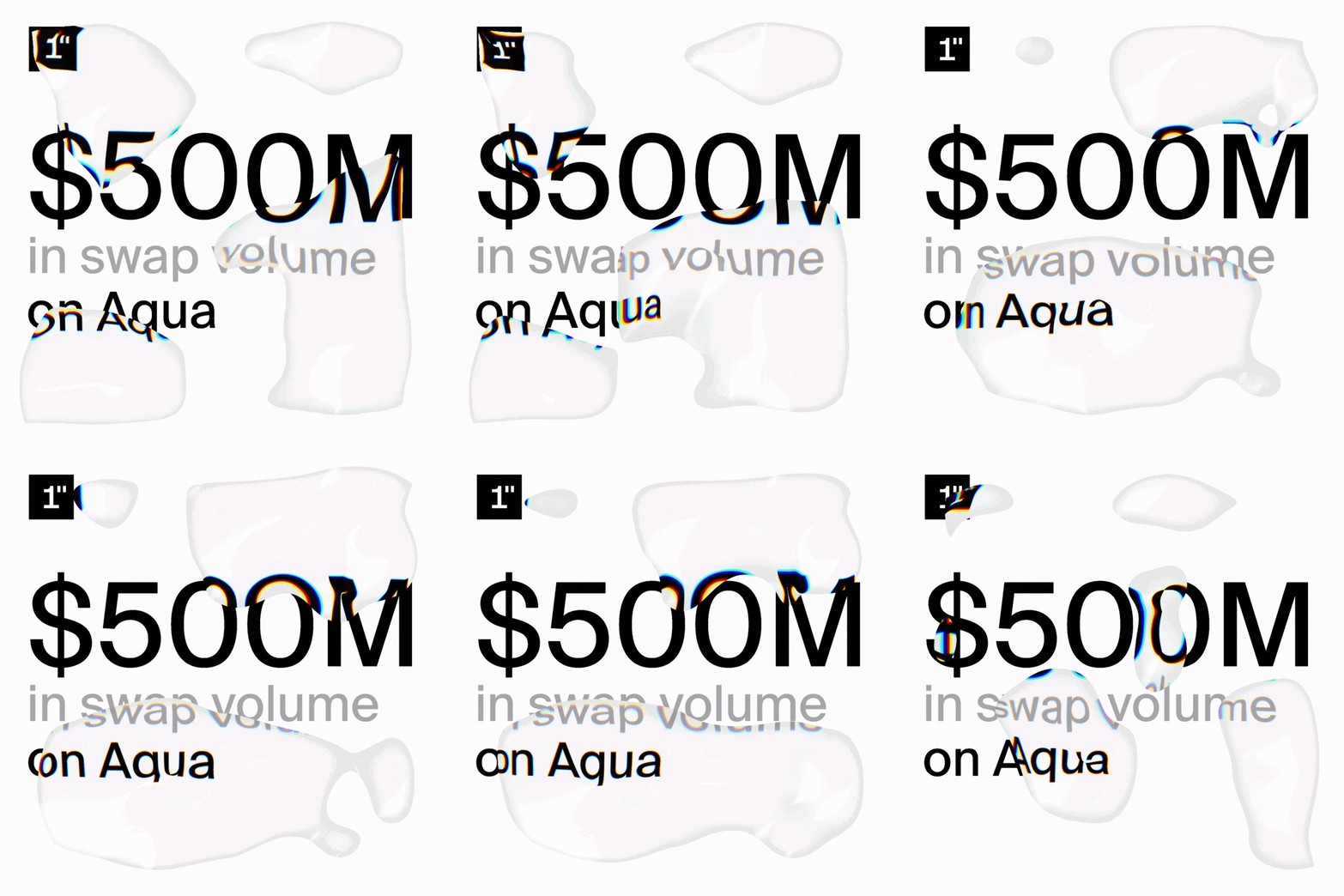
More than $500 mln in swap volume has now gone through 1inch Aqua. Every fill came directly from liquidity providers’ wallets: their tokens stayed in their wallets until the moment a swap actually filled.
What does $500 mln in swap volume look like when the liquidity was never deposited into a pool?
That is now more than a theoretical question. In early September, 1inch Aqua passed $500 mln in cumulative swap volume, according to Dune, marking a new milestone for its shared liquidity model. As of publication date, the cumulative swap volume stood at just over $520 mln.
The important part is not just the number. It is how those swaps happened.
Across that entire $500 mln, LPs did not first transfer their tokens into an Aqua pool or vault. Their assets remained in their wallets until individual swaps filled. Only then did the relevant tokens move as part of the transaction.
From launch to $500 mln
1inch Aqua officially launched on July 28, 2026, following a developer release in November 2025. It was built around a different approach to DeFi liquidity: instead of requiring capital to be deposited into isolated pools, Aqua lets the same wallet balance support multiple liquidity positions.
Adoption started quickly. Soon after its public launch, Aqua passed $100 mln in swap volume. Now cumulative volume has crossed $500 mln, with roughly 4,500 open positions held by just under 600 LPs.
That growth provides an increasingly substantial real-world test of Aqua’s core idea: liquidity can remain self-custodial and still be available for swaps.
$500 mln without depositing liquidity
Traditional AMMs normally require an LP to transfer tokens into a smart-contract pool before traders can use them.
Aqua removes that deposit-and-withdraw cycle. When an LP creates an Aqua position, the tokens stay in the LP’s wallet. Aqua receives permission to access the relevant balance under the position’s conditions, but the assets are not transferred in advance. They move only when a swap fills.
So the $500 mln milestone represents more than $500 mln in swaps routed through Aqua. It represents $500 mln in swap volume filled against liquidity that remained in LP wallets right up until the swap filled.
For every individual fill, the liquidity was there when it was needed - but it did not have to sit inside a pool waiting to be used.
The same balance can do more
Keeping liquidity in the wallet also enables Aqua’s second defining feature: shared liquidity.
With a conventional pool model, capital allocated to one position generally cannot simultaneously back another. An LP who wants exposure to several strategies has to divide the available assets among them.
Aqua positions can instead reference the same approved wallet balance. One balance can therefore support multiple positions without being split into separate deposits.
The actual wallet balance remains the limit. Aqua does not multiply the LP’s assets or create leverage simply because several positions can reference them.
This makes the liquidity more flexible. Capital that is not being used by one position can still be available to another.
Liquidity moves only when the swap does
Aqua’s architecture changes a basic assumption behind liquidity provision.
Liquidity does not need to be moved somewhere first in order to become available for trading.
Instead, the position defines when and how the LP is willing to trade. The assets remain in the wallet until those conditions are met. When a swap fills, the relevant tokens move as part of the atomic transaction.
More than $500 mln in swap volume has now passed through that model.
And through every dollar of it, the same principle held: liquidity stayed with the LP until there was an actual swap to fill.
Explore 1inch Aqua and discover shared, self-custodial liquidity.
Disclaimer: This content is provided for informational purposes only. Nothing in this material constitutes financial, investment, legal or tax advice, or a recommendation to enter into any transaction. Interacting with Aqua involves risk, including the possible loss of all funds involved. Fees are not guaranteed.
Join us


